CORYNEX™ Microbial Protein and Peptide Expression Platform
Our CORYNEX™ microbial protein and peptide expression technology uses the Gram-positive bacterium Corynebacterium glutamicum to produce endotoxin-free recombinant proteins and long-chain peptides with high purity, scalability, and efficiency.

CORYNEX™ vs. Competitive Expression Systems
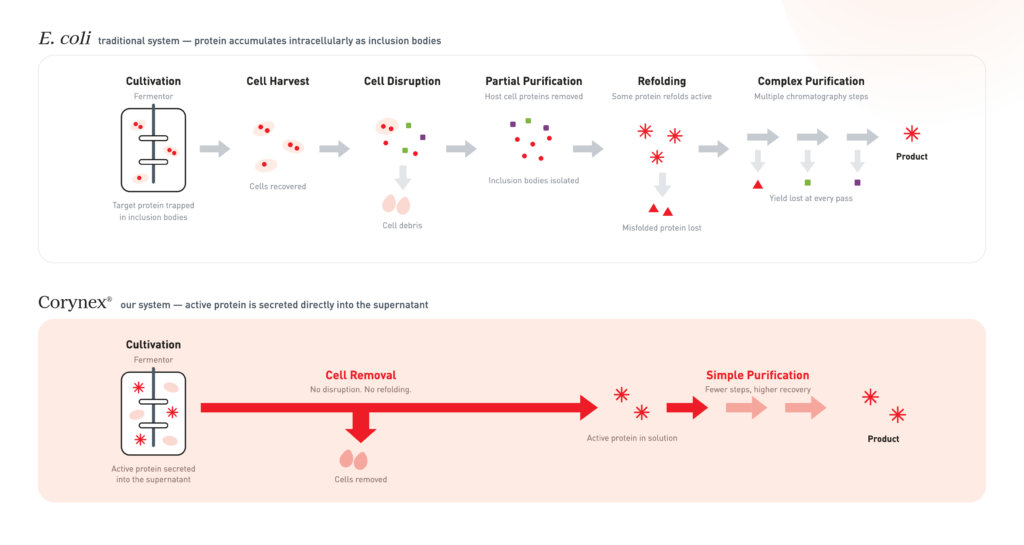
CORYNEX™ combines the advantages of traditional E. coli, CHO, and Yeast platforms. It secretes targets directly into the media with high titers and purity, without endotoxins, cell lysis, protein refolding, or complex purification steps. It is fast-growing and scalable, leading to higher overall productivity.
How CORYNEX™ Works
CORYNEX™ puts secretion to work. Using the Gram-positive bacterium Corynebacterium glutamicum, the platform secretes proteins and peptides directly into the culture medium for streamlined product recovery. Its proprietary, LPS endotoxin-free host and optimization tools enable efficient production tailored to each target.
Simplified, Fast, and Scalable Production
The CORYNEX™ expression system removes three of the highest cost and time drivers in microbial biologics manufacturing: LPS purification, inclusion body refolding, and the scale limitations of column-bound platforms.
No LPS, No Inclusion Bodies, and Active Without Refolding
C. glutamicum produces no LPS (lipopolysaccharide) — eliminating the endotoxin removal burden inherent to E. coli systems. Direct secretion means the protein folds correctly in the culture medium. Purification starts from a clean baseline.
Faster Time to Material
Fewer purification steps and no refolding cycles translate directly to faster timelines. From strain development through first GMP batch, CORYNEX™ programs move faster than E. coli inclusion body routes — with fewer failure modes.
Clinical and Commercial-Scale Fermentation
CORYNEX™ achieves titers of 10 g/L and higher — competitive with best-in-class microbial expression. Standard fermentation equipment. Lower manufacturing costs vs. mammalian cell culture. 60+ years of C. glutamicum industrial fermentation expertise.
Phase II
Clinical trial experience
~15 kL
Achieved in GMP run
11
Patents
Production Examples by Molecule Class

VHH Antibodies
Secreted in active, properly folded form — no refolding required. High titer via CORYNEX™. Applicable to therapeutic VHHs, diagnostic VHHs, VHH-drug conjugates, and multi-specific formats.

PAS Fusion Proteins
Half-life-extended proteins using PAS sequences. CORYNEX™ as the secretory expression platform; XL-protein as the PASylation® technology partner. Applicable to VHHs, peptides, and other rapidly cleared therapeutic proteins as a biological alternative to PEGylation.

Long-Chain Peptides
Scalable and sustainable manufacturing of long-chain peptides and peptide fragments composed of natural amino acids, delivering high titers, purity, and overall productivity. Applicable to GLP-1-related and other long-acting peptides and peptide fragments for downstream conjugation.

Simplified Downstream = Less Waste
Fewer purification steps mean fewer solvents, fewer column volumes, and less buffer waste per gram of product — a measurable environmental benefit vs. inclusion body routes, producing less protein loss and overall yield is increased, reduction in waste, time, and cost.

Ready to Move Forward?
Let’s discuss how CORYNEX™ can support your protein or peptide program from development through GMP supply.
Frequently Asked Questions
What is CORYNEX™ and how does it differ from E. coli expression systems?
CORYNEX™ is Ajinomoto Bio-Pharma Services’ proprietary microbial expression technology based on the Gram-positive bacterium Corynebacterium glutamicum. Target proteins and peptides are secreted directly into the culture medium in active, properly folded form, eliminating the need for cell lysis, inclusion body isolation, and refolding. Because C. glutamicum does not produce LPS endotoxin, CORYNEX™ also avoids the endotoxin removal burden associated with E. coli-based expression and can support simplified downstream purification.
What types of targets are well suited for CORYNEX™?
CORYNEX™ is well suited for non-glycosylated targets such as VHH antibodies, long peptides, antibody fragments, and other recombinant targets where endotoxin-free and highly productive manufacturing is a priority.
How is CORYNEX™ endotoxin-free?
CORYNEX™ can avoid endotoxin contamination because it is based on the Gram-positive bacterium C. glutamicum, which doesn’t produce any endotoxins.
Can CORYNEX™ be adapted for my specific protein target?
Yes. Strain engineering and process customization for client-specific target molecules are at the core of the CORYNEX™ service model. Experts at Ajinomoto Bio-Pharma Services’ R&D center in Kawasaki, Japan work closely with clients to adapt CORYNEX™ to their specific protein target.
Can CORYNEX™ match E. coli yields?
Yes. CORYNEX™ is expected to achieve productivity comparable to, or better than, E. coli without the need for cell lysis, protein refolding, and endotoxin removal.