
CpG-ODN TLR9 Agonists
CpG-ODNs are synthetic oligonucleotides designed to activate Toll-like receptor 9 (TLR9) and support immune response research. We offer CpG-ODN agonists and corresponding controls for research applications worldwide.

CpG-ODN
CpG-ODN is available to customers worldwide.
We offer high-quality TLR9 agonists and their controls for activating immune cells. This product is a reagent for research. It cannot be used for clinical purposes.
Product Details
Overview
Toll-like receptors (TLRs) recognize highly conserved structural motifs as one of the early innate immune responses to invading pathogens. TLR 9 distinguishes mammalian and bacterial DNA and induces activation of immune cells.
A synthetic oligonucleotide containing a CpG motif has the effect of stimulating the immune system, promoting the maturation and activation of antigen-presenting cells, and the induction of Th1 and inflammatory cytokines.
- Immune stimulation of potent and specific human and mouse immune cells, and for animal experiments
- Offered in encapsulated vials in high purity
- Guaranteed endotoxin 0.5 EU / mg or less
- Easy handling
Product Details
TLR9 agonists of different classes have been shown to have different effects on cells. Please select the agonist that is best suited for your needs.
A-class TLR9 ligand: D35
- Induction of high type I IFN production
- Low activity against B cells
- It is useful for activation of pDC and induction of IFN-α from PBMC, activation of IFN-signal pathway
B-class TLR9 ligand: K3
- Stimulates B cells and activates TLR9-dependent NF-kB signal
- Low activity for induction of FN-α
- B-class is useful for activation of B cell, induction of IL-6 from human PBMC, activation of NF-kB signal pathway
CpG-ODN Activity evaluation
Example 1: Cytokine induction in human PBMC
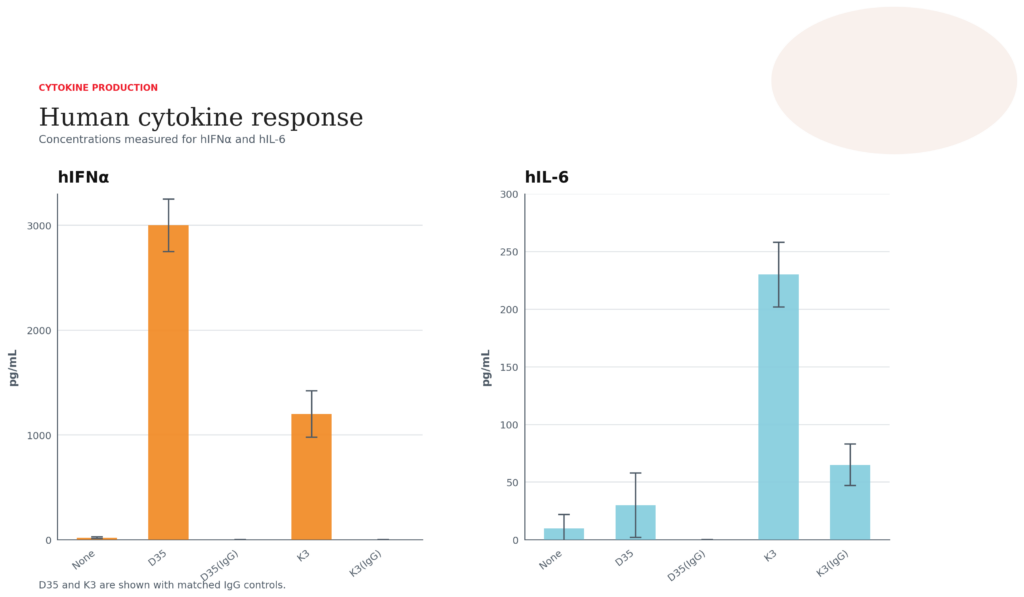
Human IFN-a and IL-6 concentrations in culture supernatants were measured by ELISA for 24 hours after stimulation of human PBMC (1 x 10⁶ cells) with 1 uM of each CpG. The bar graph shows the mean average ± SEM.
Example 2: Cytokine induction in mouse FL-DC
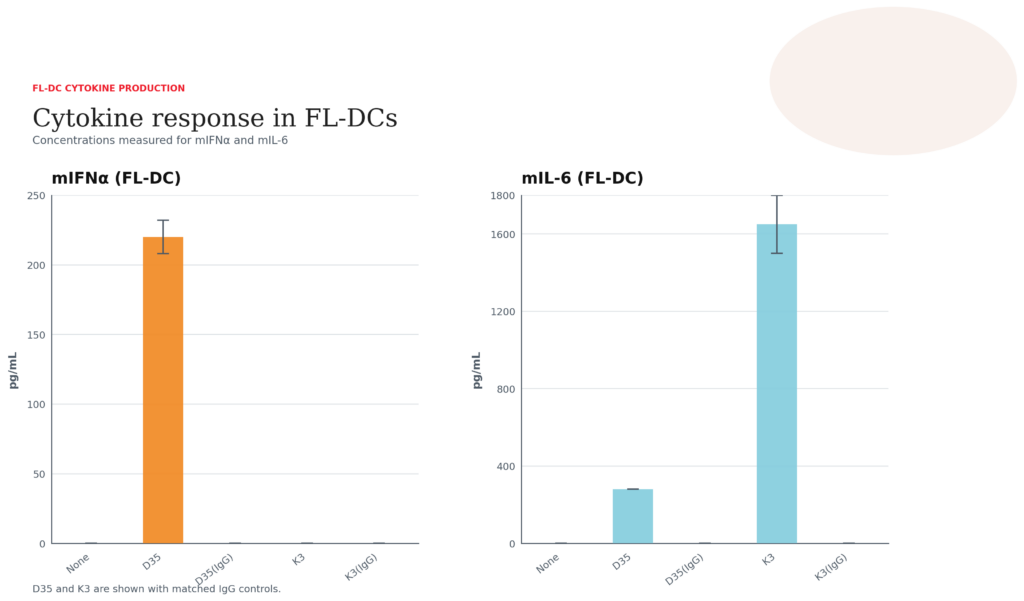
Human IFN-a aMurine IFN-a and IL-6 concentrations in the culture supernatant of the mouse bone marrow-derived FL-DC (2 × 10 6 cells) induced to differentiate with FLT 3 L were stimulated with 1 uM of each CpG for 24 hours and then measured by ELISA. The bar graph shows the mean average ± SEM.
This data is provided as a result of collaborative research with Professor Ken Ishii and Professor Daiki Aoshi, Adjuvant Development Project of the National Institute of Pharmaceutical Sciences.
References:
1: Ishii KJ, Gursel I, Gursel M, Klinman DM. Immunotherapeutic utility of stimulatory and suppressive oligodeoxynucleotides.
Curr Opin Mol Ther. 2004 Apr; 6 (2): 166-74.
2: Verthelyi D, Ishii KJ, Gursel M, Takeshita F, Klinman DM. Human peripheral blood cells differentially recognize and respond to two distinct CPG motifs.
J Immunol. 2001 Feb 15; 166 (4): 2372-7.
RNA purification examples include cultured cells, bacteria, plants, and yeast.